Category Archives: Blog

Understanding Google Ads Keywords: How to Choose the Right Keywords for Your Campaigns
Introduction
Google Ads is a powerful platform for businesses to promote their products or services, but at the heart of every successful campaign lies one crucial element: keywords. Keywords are the bridge between your target audience and your ads. They allow your ads to show up when users search for relevant terms on Google. Choosing the right keywords can make the difference between a profitable campaign and one that falls flat.
In this guide, we’ll explore how keywords work in Google Ads, the different types of keywords, how to research and select the most effective keywords, and how to optimize your keyword strategy for the best results.
Topics Covered in This Blog
- What Are Keywords in Google Ads?
- Why Keywords Are So Important for Your Google Ads Campaigns
- Types of Keywords in Google Ads
- How to Conduct Keyword Research for Google Ads
- Choosing the Right Keywords for Your Campaigns
- Using Keyword Match Types Effectively
- Utilizing Negative Keywords to Refine Your Targeting
- Optimizing Your Keyword Strategy Over Time
1. What Are Keywords in Google Ads?
In Google Ads, keywords are words or phrases that advertisers use to target their ads to specific search queries. When a user types a query into Google that matches or is closely related to the keywords you’ve selected, your ad may be shown to that user. These keywords are the foundation of your Google Ads campaigns, determining when and where your ads will appear.
For example, if you run an online clothing store that sells running shoes, your selected keywords could be “buy running shoes online,” “best running shoes,” or “affordable running shoes.” When someone types these phrases into Google, your ad may show up in the search results, providing an opportunity to attract that person to your website.
Why Are Keywords So Important?
Keywords are the primary way that Google Ads connects your business to users who are actively searching for products, services, or information. Without the right keywords, your ads won’t reach the right audience, and your campaign won’t generate the desired results. Selecting the most relevant and high-intent keywords is essential to the success of any Google Ads campaign.
2. Why Keywords Are So Important for Your Google Ads Campaigns
When you launch a Google Ads campaign, the primary goal is to connect with users who are searching for exactly what you offer. Keywords play a central role in achieving this connection. Here’s why they matter:
1. Match User Intent
The most important function of keywords is matching user intent. For instance, if someone searches for “cheap iPhone cases,” they are likely looking to make a purchase. Your ad must be designed around keywords that align with that user’s intent—whether they’re looking to buy, get information, or find a specific service.
2. Control Over Your Targeting
By selecting your keywords, you can control exactly who sees your ads. If you choose very broad keywords like “shoes,” your ad might be shown to people looking for any type of footwear. On the other hand, more specific keywords like “running shoes for men” can help narrow down the audience to those who are more likely to make a purchase.
3. Improve Your Quality Score
Google Ads uses a metric called Quality Score to measure the relevance and quality of your keywords, ads, and landing pages. The higher your Quality Score, the lower your cost-per-click (CPC) and the better your ad’s position in search results. Using relevant keywords that align with your ads and landing pages can help improve your Quality Score and reduce your advertising costs.
4. Increase Conversion Rates
Choosing the right keywords is crucial for converting clicks into valuable actions, whether that’s a sale, lead, or download. Well-targeted keywords ensure that the users who click on your ads are the ones most likely to engage with your business.
3. Types of Keywords in Google Ads
Google Ads offers several different types of keywords that you can use to target your ads. These keywords determine how closely a user’s search query needs to match your selected keywords for your ad to appear. Understanding these types and using them effectively is essential for a successful campaign.
1. Broad Match Keywords
Broad match keywords are the default option in Google Ads. When you use broad match keywords, your ad can appear for any search query that contains the keyword, variations of the keyword, synonyms, and related searches. While broad match keywords can generate a lot of traffic, they may not always be highly targeted.
Example: If your broad match keyword is “running shoes,” your ad could appear for searches like “buy running sneakers,” “best shoes for jogging,” or “footwear for runners.”
Pros:
- Can help you reach a wide audience.
- Captures related search terms you may not have thought of.
Cons:
- May lead to irrelevant clicks and low conversion rates.
- May increase your cost-per-click (CPC).
2. Phrase Match Keywords
With phrase match keywords, your ad will only show when a search query includes the exact phrase or a close variation of that phrase. The keyword must appear in the same order in the user’s search query, although other words can be added before or after the phrase.
Example: If your phrase match keyword is “running shoes for men,” your ad could appear for searches like “best running shoes for men” or “affordable running shoes for men,” but not “men’s shoes for running.”
Pros:
- Provides more targeted traffic compared to broad match.
- Helps ensure that your ad is shown to users with a clearer intent.
Cons:
- Limits the reach compared to broad match.
3. Exact Match Keywords
Exact match keywords ensure that your ad will only appear when a user’s search query exactly matches the keyword or close variations. With exact match, your keyword can appear for searches that are highly relevant to your product or service.
Example: If your exact match keyword is “best running shoes for men,” your ad will only show for that exact search term or close variations, such as “top running shoes for men.”
Pros:
- Highly targeted traffic.
- Higher conversion rates since the keyword matches the user’s intent more precisely.
Cons:
- Limited reach.
4. Negative Keywords
Negative keywords allow you to exclude specific terms from triggering your ads. This is helpful for preventing your ads from showing for irrelevant searches and ensuring you’re not wasting your budget on clicks that won’t lead to conversions.
Example: If you sell high-end running shoes, you might want to add “cheap” as a negative keyword so your ads aren’t shown to users looking for budget-friendly options.
Pros:
- Helps refine targeting and prevents irrelevant clicks.
- Increases your campaign’s efficiency.
Cons:
- Requires ongoing monitoring and adjustment.
4. How to Conduct Keyword Research for Google Ads
Keyword research is a critical step in building a successful Google Ads campaign. Here’s how you can conduct thorough keyword research:
1. Brainstorming Initial Keywords
Start by brainstorming a list of keywords related to your business, products, or services. Think about terms that potential customers might type into Google when looking for what you offer. You can also ask employees, colleagues, or friends for their input.
Example: If you sell skincare products, some initial keywords might include “best skincare products,” “anti-aging creams,” or “moisturizers for dry skin.”
2. Use Google Keyword Planner
Google’s Keyword Planner tool is a free tool that helps you find relevant keywords, estimate search volume, and see how competitive keywords are. You can enter seed keywords into the tool, and it will provide suggestions for related keywords along with data on average monthly searches, competition, and expected CPC.
3. Analyze Competitor Keywords
Take a look at the keywords your competitors are bidding on. You can use tools like SpyFu or Ahrefs to analyze their keywords and identify gaps or opportunities. By understanding what keywords are driving traffic to your competitors, you can find keywords to target in your own campaigns.
4. Review Search Terms Reports
Once your campaigns are running, you can access the Search Terms Report in Google Ads, which shows you the exact queries users are typing when they trigger your ads. Use this data to identify new relevant keywords, as well as irrelevant terms to add to your negative keyword list.
5. Choosing the Right Keywords for Your Campaigns
Now that you understand the different types of keywords and how to research them, it’s time to select the right ones for your campaign. Here are some tips for choosing the best keywords:
1. Consider Search Intent
Consider what the user is looking for when they type a keyword into Google. There are three types of search intent:
- Navigational: The user is trying to find a specific website (e.g., “Facebook login”).
- Informational: The user is seeking information (e.g., “how to start a blog”).
- Transactional: The user is looking to make a purchase or take action (e.g., “buy running shoes online”).
Focus on transactional keywords if your goal is conversions, but also consider informational keywords for content-driven campaigns.
2. Look for Long-Tail Keywords
Long-tail keywords are longer, more specific keyword phrases. While they tend to have lower search volume, they also tend to have less competition and a higher conversion rate because they’re more closely aligned with user intent.
Example: Instead of just targeting “running shoes,” a long-tail keyword could be “best running shoes for women with flat feet.”
3. Use Location-Based Keywords
If your business operates in a specific location, include location-based keywords in your campaign. These keywords can help target users in a particular geographic area and ensure your ads reach the right local audience.
Example: If you’re a running shoe store in New York, you could use keywords like “running shoes New York” or “buy running shoes in NYC.”
6. Using Keyword Match Types Effectively
Now that you have a list of keywords, it’s time to decide how you want them to match with user searches. By using different match types, you can refine your targeting and improve your ad relevance.
- Broad Match: Use broad match for maximum reach and experimentation.
- Phrase Match: Use phrase match to ensure relevance while still casting a wider net than exact match.
- Exact Match: Use exact match for highly targeted campaigns with low volume but high intent.
- Negative Keywords: Use negative keywords to filter out irrelevant traffic.
7. Utilizing Negative Keywords to Refine Your Targeting
Negative keywords are an often-overlooked feature of Google Ads, but they can help ensure your ads aren’t shown to people who are unlikely to convert. By excluding irrelevant search terms, you can prevent wasted spend and improve your campaign’s overall efficiency.
Example: If you sell premium skincare products, you might want to add “cheap” as a negative keyword to avoid showing your ads to people searching for low-cost alternatives.
8. Optimizing Your Keyword Strategy Over Time
Keyword research and selection is not a one-time task. As your campaigns run, continually monitor their performance, analyze data, and refine your keyword strategy. Regularly review the following:
- Search Terms Report: Identify new keywords that are driving valuable traffic.
- Keyword Performance: Pause underperforming keywords and reallocate budget to high-converting ones.
- Negative Keywords: Continuously update your negative keyword list based on performance data.
Conclusion
Choosing the right keywords is one of the most important aspects of a successful Google Ads campaign. By understanding the different types of keywords, conducting thorough research, and refining your keyword strategy over time, you can ensure your ads reach the right audience and generate valuable conversions. Stay informed, test different approaches, and continually optimize your keyword strategy to achieve the best results.
Keyword Research and Targeting in Google Ads: A Comprehensive Guide
Introduction
Keyword research and targeting are the foundation of a successful Google Ads campaign. In the simplest terms, keyword research helps you understand what your audience is searching for, and targeting ensures your ads reach them at the right moment. If done correctly, it allows you to create a more effective and cost-efficient ad strategy. Without proper keyword targeting, even the most compelling ad copy and creative can fail to deliver the desired results.
This guide walks you through everything you need to know about keyword research and targeting in Google Ads. By the end of this blog, you’ll have a solid understanding of how to select and optimize your keywords for maximum performance.
Topics Covered in This Blog
- What is Keyword Research?
- The Importance of Keyword Research in Google Ads
- Understanding Search Volume and Competition
- Types of Keyword Match Types in Google Ads
- Using Negative Keywords for Better Targeting
- Advanced Keyword Research Techniques
- Optimizing Keywords with Bidding Strategies
- Monitoring and Refining Keyword Performance
1. What is Keyword Research?
Keyword research is the process of identifying the terms and phrases that users type into search engines when looking for information, products, or services. In the context of Google Ads, this means finding out which words and phrases will trigger your ads to appear in the search results.
The primary goal of keyword research is to identify terms that your target audience is likely to use, then create targeted ad campaigns around those keywords. For a beginner, it may seem like a daunting task, but with the right tools and resources, it can be streamlined.
Here’s how you can start:
- Identify Seed Keywords: Think of broad terms related to your business or niche. These seed keywords will help generate more specific variations.
- Use Google’s Keyword Planner Tool: Google Ads provides a free tool that helps you find keyword ideas along with their search volume and competition level.
- Analyze Keyword Intent: Identify whether the keyword suggests a user is looking to buy, learn, or browse, so you can align your ads to match their intent.
2. The Importance of Keyword Research in Google Ads
Effective keyword research helps you reach the right audience, at the right time, with the right message. Here’s why keyword research is crucial for a successful Google Ads campaign:
- Targeted Ads: By choosing relevant keywords, you ensure your ads are shown to users who are actively searching for what you offer. This improves the chances of a click turning into a conversion.
- Improved Quality Score: Google uses a metric called Quality Score, which influences how much you pay per click. By choosing the right keywords that align with user intent and your ad copy, you can improve your Quality Score, thus lowering your overall cost per click (CPC).
- Maximized ROI: Choosing the right keywords not only saves you money by minimizing irrelevant clicks, but it also helps drive conversions, improving your overall Return on Investment (ROI). If you are not targeting the right keywords, you risk wasting your ad spend.
Ultimately, your keyword strategy is the foundation of how effective your Google Ads campaigns will be. A well-thought-out strategy ensures that your budget is used efficiently and that your ads reach the most relevant users.
3. Understanding Search Volume and Competition
Search volume refers to how often a keyword is searched in Google each month. Competition refers to how many other advertisers are bidding on that keyword. Both these metrics play a key role in your keyword selection.
- Search Volume:
- High-volume keywords are those that have a lot of searches but may be highly competitive. For instance, a keyword like “buy shoes” will have massive search volume but also high competition.
- Low-volume keywords may be less competitive, but they also tend to have lower traffic. These keywords can often result in more targeted and highly-converting visitors.
- Competition:
- High-competition keywords will typically have a higher cost-per-click (CPC). For example, keywords related to financial services like “buy insurance” are very competitive, meaning more advertisers bid for the same keyword.
- Low-competition keywords will have a lower CPC, but it’s essential to balance this with search intent. If a keyword has low competition but doesn’t match the user’s search intent, it can still be ineffective.
When conducting keyword research, you need to balance search volume and competition. The goal is to target keywords that strike a good balance between search volume and competition level.
4. Types of Keyword Match Types in Google Ads
Google Ads offers several types of keyword match types, each with its own level of precision. Understanding these match types will help you control how and when your ads are shown.
- Broad Match:
- This is the default setting for keywords in Google Ads. It matches your ad with a wide range of search queries that Google deems relevant to your keyword. While this maximizes reach, it can also bring in irrelevant clicks.
- Example: If you target the keyword “shoes,” your ad could show for searches like “buy running shoes” or “leather shoes.”
- Phrase Match:
- This allows your ad to show for searches that include the exact phrase or a close variation of it.
- Example: If you target the phrase “red shoes,” your ad could show for searches like “buy red shoes” or “affordable red shoes.”
- Exact Match:
- This match type is the most restrictive and only shows your ad for exact keyword searches or close variations.
- Example: Targeting the exact match keyword “red shoes” will only trigger your ad when a user searches for “red shoes” or very close variants.
- Modified Broad Match:
- This match type is slightly more flexible than exact match but gives you more control than broad match. It ensures that your keywords appear when certain words are included in the search query.
- Negative Keywords:
- Negative keywords prevent your ads from showing for irrelevant or unwanted search terms. This is a crucial tool for filtering out clicks that won’t lead to conversions.
5. Using Negative Keywords for Better Targeting
Negative keywords are a powerful tool in refining your Google Ads campaigns. They allow you to exclude searches that aren’t relevant to your business, ensuring that your ads aren’t shown for irrelevant queries.
For example:
- If you sell high-end shoes, you can add “cheap” or “discount” as negative keywords to avoid wasting ad spend on price-sensitive users who aren’t likely to convert.
Some strategies for using negative keywords:
- Common Negative Keywords: Words like “free,” “cheap,” and “best price” are commonly used by people who are unlikely to make a purchase.
- Negative Keyword Lists: Google Ads allows you to create lists of negative keywords that can be applied across multiple campaigns, ensuring better targeting and saving time.
Negative keywords help increase your Quality Score and improve the CTR (Click-Through Rate).
6. Advanced Keyword Research Techniques
When you’re ready to move beyond basic keyword research, there are several advanced strategies you can use:
- Competitor Analysis:
- Use tools like SEMrush, SpyFu, or Ahrefs to identify the keywords your competitors are targeting. This can provide valuable insights into the terms driving their traffic and conversions.
- Long-Tail Keywords:
- Long-tail keywords are more specific phrases with lower search volume but often higher conversion rates. For example, instead of targeting “shoes,” a long-tail keyword could be “buy waterproof running shoes for men.”
- Google Trends:
- This tool allows you to track search trends over time and understand seasonal fluctuations in interest for specific keywords. This helps in refining your targeting strategy for certain times of the year.
7. Optimizing Keywords with Bidding Strategies
Once you’ve selected your keywords, you need to optimize your bidding strategy to ensure your ads are shown to the right audience at the right cost.
- Manual Bidding: Allows you to set bids for each keyword manually. This is useful if you have a good understanding of the performance of each keyword.
- Automated Bidding: Google’s automated bidding strategies aim to maximize conversions or clicks based on your target goals.
Choose a bidding strategy that aligns with your objectives and budget.
8. Monitoring and Refining Keyword Performance
Keyword optimization is not a one-time task. Regularly monitoring keyword performance and refining your strategy is crucial for ongoing success.
- Track Metrics: Keep an eye on important metrics like CTR, Conversion Rate, and Quality Score.
- A/B Testing: Test different versions of your ads and landing pages to see which keywords generate the best performance.
For continuous improvement, you’ll need to test, analyze, and adjust your strategy regularly.
Conclusion
Keyword research and targeting are critical elements for a successful Google Ads campaign. By identifying the right keywords, targeting them strategically, and monitoring their performance, you can improve the effectiveness of your ads, maximize your budget, and drive more qualified traffic.
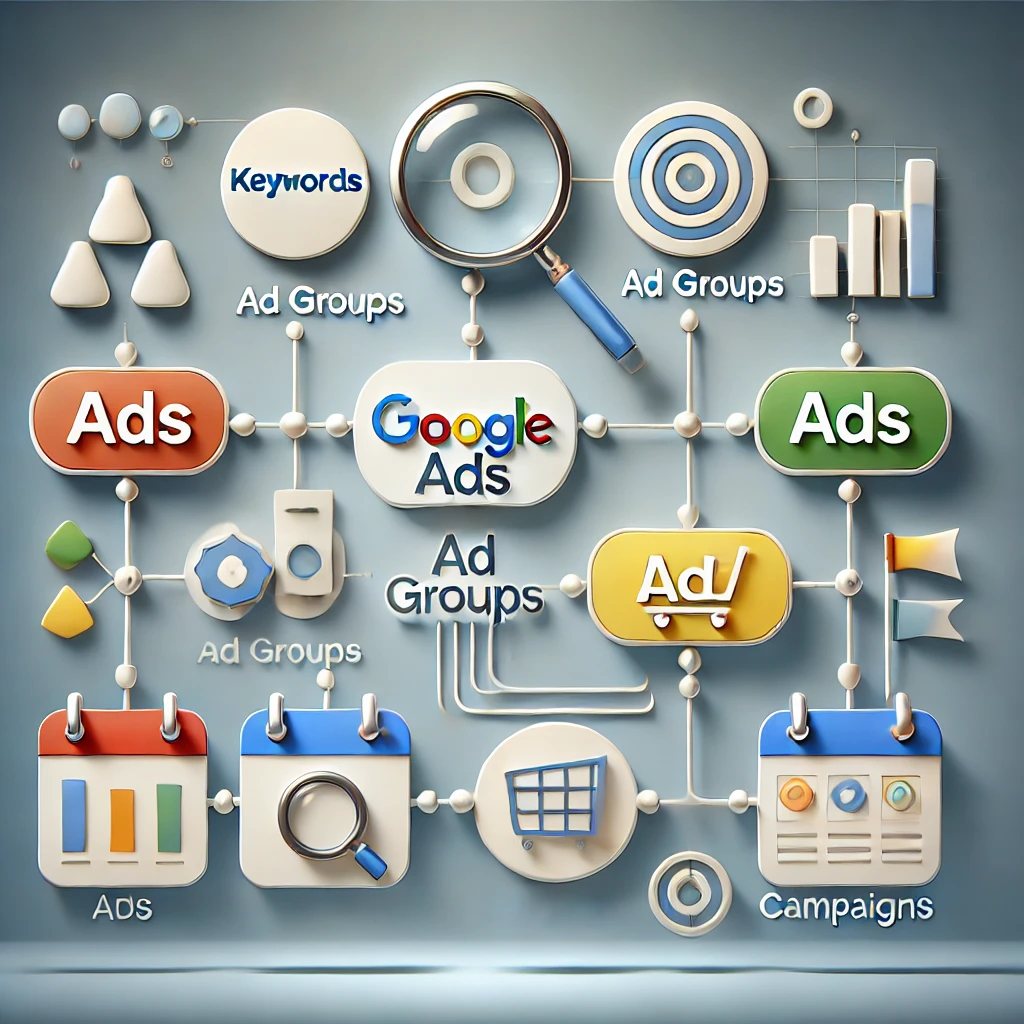
Key Components of a Google Ads Campaign
Google Ads campaigns are complex systems designed to deliver highly targeted, measurable advertising. Understanding and mastering their components—campaigns, keywords, ad groups, and ads—allows marketers to achieve exceptional results. In this guide, we dive deep into each component, explaining their purpose, configuration, and contributions to the overall success of your campaigns.
Campaigns: The Strategic Foundation
1. Campaign Overview and Purpose
Campaigns represent the highest level of the Google Ads structure. A campaign organizes settings, budget allocation, and overarching targeting goals.
2. Types of Campaigns
Google Ads supports various campaign types, each suited to different business objectives:
- Search Campaigns: Display text ads triggered by keywords.
- Display Campaigns: Show visual ads on Google’s partner sites.
- Shopping Campaigns: Showcase product-specific ads for e-commerce.
- Video Campaigns: Promote videos on YouTube and other partner platforms.
- Performance Max Campaigns: Use AI to serve ads across all Google channels.
3. Campaign Settings
- Budgeting: Allocate a daily budget to control spending. For example, an e-commerce business might assign a higher budget to campaigns focused on high-margin products.
- Bidding Strategies: Choose between options like:
- Maximize Conversions: AI-driven bidding for optimal results.
- Target CPA (Cost per Acquisition): Focus on specific cost-per-conversion goals.
- Targeting Parameters: Control where and when ads appear by setting:
- Geographical Targeting: Ads can target cities, countries, or radii around specific locations.
- Audience Segmentation: Define who sees the ads based on demographics, interests, or behaviors.
4. Impact on Campaign Success
Campaign-level decisions determine your ad visibility and return on investment (ROI). Misaligned objectives or improper configurations can lead to wasted budgets.


Keywords: The Foundation of Relevance
1. The Role of Keywords
Keywords trigger ads when a user performs a search query. They connect user intent to your product or service offerings.
2. Keyword Match Types
- Broad Match: Captures related variations of a search term. Example: “running shoes” may trigger searches for “best shoes for jogging.”
- Phrase Match: Triggers searches containing the exact keyword phrase.
- Exact Match: Matches only the precise keyword.
- Negative Keywords: Block irrelevant traffic by excluding certain words. Example: Adding “free” as a negative keyword if your products aren’t free.
3. Keyword Research Techniques
- Google Keyword Planner: Identify high-volume, low-competition keywords.
- Third-Party Tools: SEMrush, Ahrefs, and Moz provide additional insights.
- Competitor Analysis: Analyze competitors’ keyword strategies to uncover opportunities.
4. The Relationship Between Keywords and Campaign Performance
Keywords with high intent drive better traffic and conversions. Misaligned keywords can lead to low-quality scores, high costs, and low CTR.

Ad Groups: Organizing Campaign Structure
1. What Are Ad Groups?
Ad groups sit within campaigns and organize keywords and ads into tightly themed clusters. Each ad group focuses on a specific theme, product, or service.
2. How Ad Groups Enhance Campaign Efficiency
- Thematic Organization: Ad groups ensure that related ads and keywords are grouped together. For example, an online clothing store might have separate ad groups for “Men’s T-Shirts,” “Women’s Dresses,” and “Kids’ Apparel.”
- Improved Ad Relevance: Grouping keywords with corresponding ads increases relevance, boosting Quality Scores and lowering CPC.
3. Structuring Effective Ad Groups
- Tightly Themed Keywords: Avoid grouping unrelated keywords to maintain relevance.
- A/B Testing: Include multiple ad variations within an ad group to determine which performs best.
4. Common Pitfalls in Ad Group Organization
- Overloading Ad Groups: Including too many keywords can dilute the ad relevance.
- Poorly Defined Themes: Ambiguous grouping can confuse ad delivery and lower performance.

Ads: The Visible Face of Campaigns
1. Types of Google Ads
- Search Ads: Appear as text ads on Google Search results.
- Display Ads: Visual ads that show on websites within the Google Display Network.
- Video Ads: Run on YouTube and other video platforms.
- Shopping Ads: Showcase product details, prices, and images directly in search results.
2. Anatomy of a Google Search Ad
- Headline (Part 1 & 2): The first point of attention. Make it compelling and relevant. Example: “Shop Affordable Running Shoes.”
- Description: Provide additional information and a strong call-to-action (CTA), such as “Order now for free shipping!”
- Display URL: Showcases the destination website in a user-friendly format.
3. Crafting Effective Ad Copy
- Keyword Integration: Use relevant keywords to align with user intent.
- Focus on Benefits: Highlight unique selling points (USPs), such as discounts or features.
- Call-to-Action (CTA): Guide the user toward the desired action, e.g., “Sign Up Today.”
4. Using Extensions to Enhance Ads
Ad extensions improve visibility and click-through rates by providing extra information. Types include:
- Sitelink Extensions: Highlight additional pages on your website.
- Call Extensions: Add phone numbers for immediate contact.
- Price Extensions: Show pricing information for products.

Synergy Between Components
1. Interdependence of Campaign Components
While campaigns define the strategy, keywords, ad groups, and ads execute it. Effective synergy among components ensures cohesive messaging, higher quality scores, and better ROI.
2. Example of a Well-Coordinated Campaign
- Campaign Goal: Drive sales for a new running shoe.
- Ad Group: “Men’s Running Shoes” with keywords like “best running shoes for men.”
- Ads: Highlight features, such as durability and comfort, with a CTA like “Order Today for Free Shipping.”
3. Regular Monitoring and Optimization
Continuous analysis and refinement ensure optimal performance. Key metrics include:
- CTR (Click-Through Rate): Reflects ad engagement.
- Conversion Rate: Measures how many users take the desired action.
- Quality Score: Google’s evaluation of ad relevance and keyword alignment.
Best Practices for Optimizing Campaigns
1. Conduct Data-Driven Adjustments
- Monitor Search Queries: Identify irrelevant terms triggering ads and add them as negative keywords.
- Adjust Bid Strategies: Reallocate resources to high-performing campaigns.
2. Leverage Automation Tools
Google Ads offers AI-driven tools like Smart Bidding, which optimize for conversions based on historical data.
3. Implement Remarketing Campaigns
Re-engage users who previously interacted with your website by serving tailored ads that encourage conversion.
Final Thoughts
A successful Google Ads campaign is a combination of strategic planning, precise targeting, and ongoing optimization. By mastering the core components—campaigns, keywords, ad groups, and ads—you can drive impactful advertising that resonates with your target audience. Use this guide as a foundation to build campaigns that deliver measurable success and sustained growth.


The Critical Role of UI and UX in Digital Marketing
In today’s hyper-connected digital landscape, where attention spans are dwindling and competition is fierce, businesses must leverage every tool available to capture and retain customer interest. Among these tools, User Interface (UI) and User Experience (UX) design stand out as critical elements that directly influence the effectiveness of digital marketing strategies. This comprehensive examination delves into the technical aspects of UI and UX, illustrating their significance in digital marketing through data, methodologies, and case studies.
Understanding UI and UX
What is User Interface (UI)?
User Interface (UI) encompasses all the visual elements that users interact with on a digital platform. This includes layout, colors, fonts, buttons, icons, and images. The primary goal of UI design is to create an aesthetically pleasing interface that facilitates usability and enhances user interaction.
Key Components of UI
- Visual Design: The use of color schemes, typography, and imagery to create an attractive interface.
- Interactivity: Elements such as buttons, sliders, and form fields that users interact with.
- Information Architecture: The organization and structure of content on a website or application to facilitate easy navigation.
- Responsiveness: Ensuring that UI elements function well across a variety of devices and screen sizes.
What is User Experience (UX)?
User Experience (UX) refers to the overall experience a user has while interacting with a product or service, encompassing all aspects of the end-user’s interaction with the company, its services, and its products. UX design focuses on creating a meaningful and relevant experience for users through usability, accessibility, and pleasure.
Key Components of UX
- Usability: How easy and intuitive it is for users to accomplish their tasks on a digital platform.
- User Research: Gathering insights about user needs and behaviors through methods like surveys, interviews, and usability testing.
- User Journey Mapping: Visualizing the steps a user takes to achieve their goals, identifying pain points and opportunities for improvement.
- Accessibility: Ensuring that digital products are usable by people with various disabilities and challenges.
The Interplay Between UI and UX
While UI and UX are distinct components, they are intricately linked. A beautifully designed UI can enhance UX, while a poorly designed UI can ruin an otherwise great user experience. Consider the following interactions:
- A button that is visually appealing but poorly placed may confuse users, detracting from their overall experience.
- Conversely, a well-structured layout that emphasizes usability can enhance the aesthetic value of the interface.
The Importance of Research in UI/UX
Both UI and UX rely heavily on research to inform design decisions. Understanding user behavior, preferences, and pain points can lead to more effective design strategies.
- User Testing: Conducting usability tests to observe how real users interact with a product helps identify areas of improvement.
- A/B Testing: Comparing two versions of a webpage to see which performs better can inform design choices.
- Analytics: Utilizing tools like Google Analytics can provide insights into user behavior, including bounce rates, session duration, and conversion paths.
The Impact of UI/UX on Digital Marketing
1. Enhanced Conversion Rates
Conversion rate optimization (CRO) is a critical aspect of digital marketing, and UI/UX plays a fundamental role. Conversion rates measure the percentage of users who complete a desired action, such as filling out a form, signing up for a newsletter, or making a purchase. According to Unbounce, even a small increase in conversion rates can lead to substantial revenue growth.
Key Strategies for Improving Conversion Rates
- Clear Call-to-Actions (CTAs): UI should include prominent and compelling CTAs that guide users towards desired actions. For example, using contrasting colors for buttons can make them stand out.
- Simplified Forms: UX design should prioritize form fields that are easy to complete. Reducing the number of required fields can significantly decrease form abandonment rates. HubSpot found that reducing the number of form fields from 5 to 3 increased conversions by 50%.
- Trust Signals: Incorporating elements like customer testimonials, reviews, and security badges within the UI can enhance credibility and encourage users to convert.
2. Reduced Bounce Rates
Bounce rate is a crucial metric that indicates the percentage of visitors who leave a site after viewing only one page. A high bounce rate can signal poor user experience, which can significantly impact a website’s SEO ranking.
Techniques to Lower Bounce Rates
- Fast Loading Times: According to Google, 53% of mobile users abandon sites that take longer than three seconds to load. Optimizing images, leveraging browser caching, and minimizing HTTP requests can improve load times significantly.
- Engaging Content: UI/UX should facilitate easy access to engaging content. Using videos, infographics, and interactive elements can keep users on the page longer.
- Responsive Design: With an increasing number of users accessing websites via mobile devices, responsive design is essential. A seamless experience across all devices can significantly lower bounce rates.
3. Increased Customer Satisfaction and Retention
Customer satisfaction is directly correlated with user experience. Satisfied users are more likely to return and become loyal customers, which is invaluable in the competitive digital marketing landscape.
Strategies for Enhancing Customer Satisfaction
- Personalization: Tailoring the user experience based on individual preferences can enhance satisfaction. For instance, displaying personalized product recommendations based on previous purchases can create a more engaging shopping experience.
- Feedback Mechanisms: Incorporating UI elements such as surveys or feedback forms allows users to voice their opinions, leading to continuous improvement in UX.
- Post-Purchase Experience: Ensuring that the user experience extends beyond the initial purchase can lead to higher satisfaction. This includes clear communication regarding order status, easy returns, and follow-up surveys.
4. Higher Engagement Rates
Engagement metrics, such as time spent on site, pages per session, and interaction rates, are directly influenced by UI/UX. Higher engagement often translates into better conversion rates and customer retention.
Techniques to Boost Engagement
- Interactive Elements: Incorporating gamification elements, quizzes, and interactive content can increase user engagement. Research from HubSpot shows that interactive content generates 2x more conversions than static content.
- Visual Hierarchy: A well-structured layout that utilizes visual hierarchy (size, color, placement) can draw users’ attention to key information, enhancing engagement.
- Microinteractions: Small animations or feedback mechanisms that respond to user actions (like hover effects or notifications) can create a more dynamic and engaging experience.
5. Improved Brand Perception
UI/UX plays a crucial role in shaping the perception of a brand. A well-designed digital presence enhances credibility and trustworthiness, impacting how users view the brand.
Strategies to Enhance Brand Perception
- Consistent Branding: Ensuring that UI elements are consistent with the brand’s identity (colors, typography, imagery) helps build a strong brand presence. Consistency fosters familiarity, which is key to trust.
- Professionalism: A polished, professional interface can enhance user perception. According to a Stanford study, 75% of users admit to judging a company’s credibility based on its website design.
- Social Proof: Incorporating elements such as customer reviews, case studies, and testimonials in the UI can enhance brand credibility and influence purchasing decisions.
The Technical Aspects of UI/UX Design
UI Design Best Practices
- Typography: Choose fonts that are easy to read and align with the brand’s voice. Maintain a hierarchy by varying font sizes and weights for headings, subheadings, and body text.
- Color Theory: Understanding color psychology can guide UI decisions. For instance, blue often conveys trust, while red can create urgency. Consistent color schemes enhance brand recognition.
- Grid Systems: Utilizing a grid system can create a balanced and organized layout. This aids in aligning UI elements and creating visual harmony.
- Whitespace: Adequate spacing around elements prevents clutter and improves readability. Effective use of whitespace guides user focus and enhances UX.
- Icons and Imagery: Use icons to simplify navigation and communicate actions. High-quality imagery can enhance aesthetic appeal but should be optimized for fast loading times.
UX Design Best Practices
- User-Centered Design: Prioritize user needs by conducting thorough research and user testing. Understanding target demographics and their behaviors is essential for effective UX design.
- Iterative Design Process: Utilize an iterative approach, where designs are continuously refined based on user feedback. This approach fosters adaptability and responsiveness to user needs.
- Accessibility Compliance: Follow guidelines set by the Web Content Accessibility Guidelines (WCAG) to ensure that digital products are usable by individuals with disabilities. Consider color contrast, text alternatives, and keyboard navigability.
- Data-Driven Decisions: Use analytics and user feedback to inform design choices. Tools like Google Analytics and Hotjar provide valuable insights into user behavior.
- Emotional Design: Incorporate elements that evoke positive emotions, such as friendly illustrations or encouraging language. Emotional connections can enhance user satisfaction and loyalty.
Case Studies: Successful Implementation of UI/UX in Digital Marketing
1. Airbnb
Airbnb is a prime example of effective UI/UX design in action. The platform’s UI is clean and visually appealing, with a focus on high-quality images of listings. UX is enhanced through intuitive navigation, comprehensive search filters, and a user-friendly booking process.
- Impact: Airbnb’s design has contributed to its significant growth, with over 7 million listings worldwide. The seamless experience fosters user trust and satisfaction, encouraging repeat bookings.
2. Amazon
Amazon’s UI/UX is finely tuned to optimize the shopping experience. Features such as personalized recommendations, one-click purchasing, and easy return processes enhance user satisfaction and increase conversion rates.
- Impact: Amazon’s emphasis on UX has made it the go-to e-commerce platform, with a staggering $469.8 billion in revenue in 2021. The focus on customer-centric design leads to higher retention and lifetime value.
3. Slack
Slack’s UI design combines simplicity with functionality. The platform’s UX focuses on seamless collaboration, with features like channel organization and direct messaging designed for ease of use.
- Impact: Slack’s user-friendly design has propelled its adoption, boasting over 16 million daily active users. The positive user experience drives engagement and fosters team collaboration.
Future Trends in UI/UX and Digital Marketing
1. Voice User Interface (VUI)
With the rise of voice-activated devices, optimizing UI/UX for voice interactions will be essential. Marketers must adapt to accommodate voice search and ensure a seamless experience for users interacting via voice commands.
2. Augmented Reality (AR) and Virtual Reality (VR)
As AR and VR technologies continue to advance, brands will leverage immersive experiences to engage users. This shift will require innovative UI/UX design to create intuitive interactions within virtual environments.
3. Personalization through AI
Artificial Intelligence (AI) will play an increasingly prominent role in personalizing user experiences. By analyzing user data, AI can deliver tailored content and product recommendations, enhancing satisfaction and engagement.
4. Sustainability and Ethical Design
With growing awareness around sustainability, designers will need to consider the environmental impact of their choices. Ethical design practices, such as reducing digital waste and ensuring equitable access, will become more prominent.
Conclusion
The role of UI and UX in digital marketing is paramount. As businesses compete for attention in a crowded digital landscape, investing in high-quality UI/UX design becomes a necessity rather than a luxury. By enhancing conversion rates, reducing bounce rates, increasing customer satisfaction, boosting engagement, and improving brand perception, effective UI/UX design serves as a powerful catalyst for success.
In an era where user expectations are higher than ever, brands must prioritize user-centric design principles. The interplay between technology, creativity, and human behavior will shape the future of digital marketing, making UI and UX a cornerstone of effective strategies.
As businesses continue to navigate the complexities of the digital marketplace, embracing the principles of UI and UX design will be essential for driving engagement, loyalty, and ultimately, revenue.

The Ultimate Guide to Digital Marketing for Beginners in 2024″
Introduction
Digital marketing is rapidly evolving, making it essential for businesses to stay updated with the latest trends, tools, and strategies. Whether you’re a small business owner, an aspiring marketer, or someone just curious about how digital marketing works, this guide will walk you through the basics, providing the knowledge you need to build an effective digital marketing strategy for 2024.
What is Digital Marketing?
Digital marketing refers to the promotion of products or services using digital technologies, primarily through the internet but also including mobile phones, display advertising, and any other digital medium. Unlike traditional marketing methods, digital marketing allows businesses to reach a global audience in a cost-effective and measurable way.
Key Components of Digital Marketing:
- Search Engine Optimization (SEO): Optimizing your content to rank higher on search engines like Google.
- Content Marketing: Creating valuable content to attract and engage an audience.
- Social Media Marketing: Promoting your brand through platforms like Facebook, Instagram, LinkedIn, and Twitter.
- Pay-Per-Click Advertising (PPC): Running ads where advertisers pay each time their ad is clicked.
- Email Marketing: Communicating with your audience through personalized email campaigns.
- Affiliate Marketing: Promoting other businesses’ products for a commission.
- Influencer Marketing: Collaborating with influencers to reach a wider audience.
Why is Digital Marketing Important?
In today’s world, consumers rely heavily on digital channels to find products and services. Digital marketing helps businesses:
- Reach a larger audience than traditional methods like print ads or TV commercials.
- Target specific demographics based on interests, location, age, and more.
- Measure success in real time with analytics tools that provide data on user behavior, traffic, and conversions.
- Cost-effectiveness, as online campaigns often require less investment than traditional marketing.
- Build lasting relationships with customers through email marketing, social media, and valuable content.
Digital Marketing Strategies for 2024
To stay competitive, here are the top digital marketing strategies you should focus on in 2024:
1. Content Marketing for Voice Search: With the rise of voice search assistants like Alexa and Google Assistant, optimizing your content for voice queries is crucial. Create conversational, long-tail keyword content to increase your chances of being featured in voice search results.
2. Video Marketing Domination: By 2024, video is expected to account for more than 80% of all internet traffic. Use platforms like YouTube, Instagram Reels, and TikTok to engage your audience. Also, consider live-streaming content for a more interactive experience.
3. Personalization and AI-driven Campaigns: Artificial intelligence (AI) is transforming how businesses approach personalization. Using AI tools, you can analyze customer data to deliver tailored ads, personalized product recommendations, and unique user experiences that improve conversions.
4. Focus on Local SEO: Local SEO is vital for businesses with a physical presence. Google My Business is one of the top tools to ensure local customers can find your business. Ensure your name, address, and phone number (NAP) are consistent across platforms and encourage customer reviews.
5. Interactive Content: Content like quizzes, polls, and interactive videos encourages user engagement. Interactive content not only helps with engagement but also collects valuable data about your audience’s preferences.


SEO Best Practices for 2024
To ensure your digital marketing strategy is effective, you need to focus on SEO best practices:
1. Mobile Optimization: More than 50% of global web traffic comes from mobile devices. Your website must be responsive, load quickly on mobile devices, and provide a seamless user experience.
2. E-A-T: Expertise, Authoritativeness, and Trustworthiness: Google emphasizes content quality with its E-A-T principle. Make sure your content is informative, well-researched, and includes reputable sources. Building backlinks from authoritative websites also boosts your site’s credibility.
3. Featured Snippets and Zero-Click Searches: Optimize your content for featured snippets (the content box at the top of some search results) by providing clear, concise answers to commonly searched questions. This improves your chances of ranking at the top without users having to click through.
4. Structured Data: Implement structured data (also known as schema markup) to help search engines understand the content on your website better. This can enhance your appearance in search results with rich snippets, improving your CTR (click-through rate).
The Role of Social Media in Digital Marketing
Social media platforms continue to evolve as powerful marketing tools. Here’s how businesses should approach social media in 2024:
- Instagram and TikTok for Younger Audiences: These platforms remain dominant for brands targeting millennials and Gen Z. Focus on visually appealing content and user-generated content.
- LinkedIn for B2B Marketing: LinkedIn is the top platform for business-to-business marketing, offering targeted advertising and networking opportunities.
- Facebook for Targeted Ads: Despite competition, Facebook’s advertising platform remains one of the most powerful for highly targeted ad campaigns.
Pro Tip: Keep an eye on emerging platforms like Clubhouse and Threads. They might not be mainstream yet, but early adoption can give you a competitive edge.
Email Marketing: Still Relevant in 2024
Email marketing remains one of the most cost-effective forms of digital marketing. In 2024, successful email marketing strategies will be:
- Personalized and segmented: Use data to segment your audience and send tailored messages.
- Mobile-friendly: Most users check emails on their phones, so ensure your emails are mobile-optimized.
- Interactive elements: Include polls, quizzes, or videos in your emails to boost engagement rates.
Measuring Success: Key Digital Marketing Metrics
To gauge the success of your digital marketing efforts, focus on the following key metrics:
- Website traffic: Track how much traffic your campaigns are driving to your site.
- Conversion rate: Measure how many visitors are completing desired actions (e.g., purchases, sign-ups).
- Customer acquisition cost (CAC): Understand how much it costs to acquire a new customer through various marketing efforts.
- Return on investment (ROI): Track whether your digital marketing campaigns are bringing in more revenue than they cost.